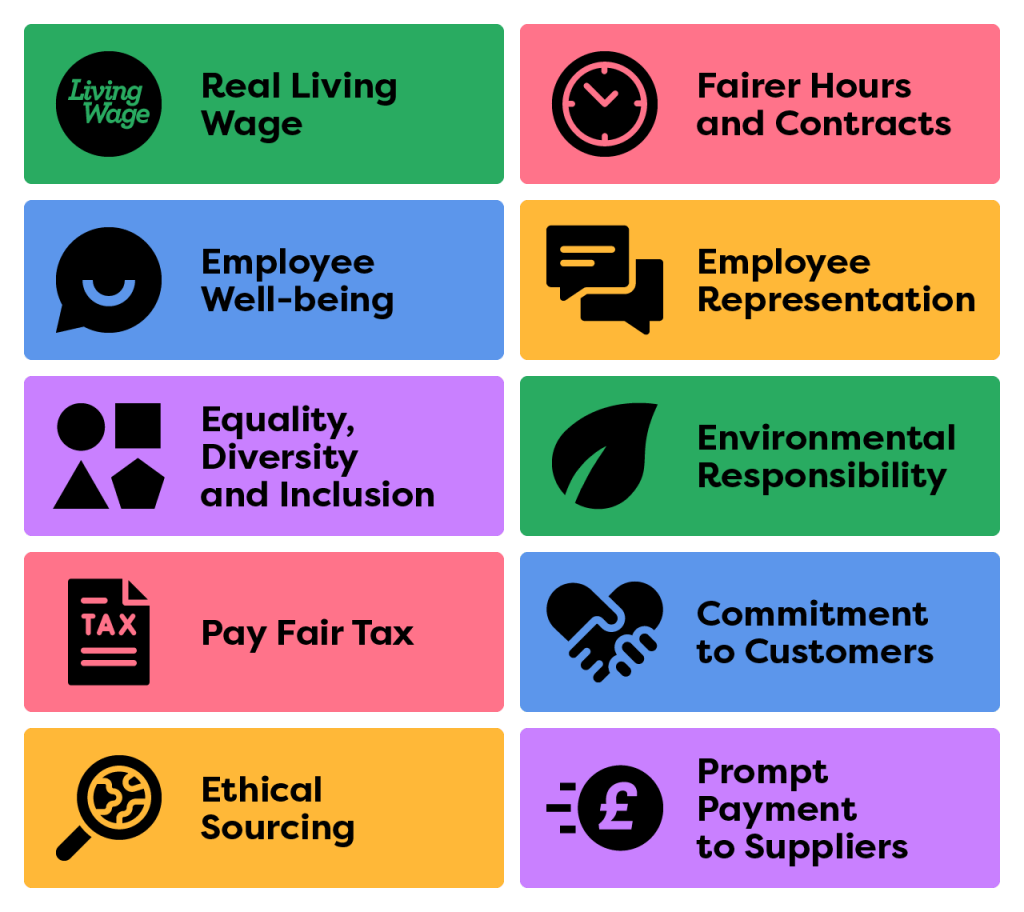
I am committed to running my business in a socially responsible and ethical way, and I am proud to have held Good Business Charter accreditation since 2021.
I renew my accreditation annually, demonstrating each year how I meet the components.
This page gives examples of what I do and some of the reasons why.
Employee Well-being
Although this is aimed at employees, I take my own well-being seriously and make sure I have a good work-life balance. It is tempting to take on any and all work offered – because, like most freelancers, I have experienced the ‘feast and famine’ cycle – but I am careful not to build up a schedule that will leave no time for rest and enjoyment. I take time to exercise, socialise, follow hobbies and volunteer in my community.
Potential clients may be disappointed that I cannot always take on a project at their ideal time. But when I do come to work on it, I will be more focused and better able to deal with any issues that arise.
Equality, Diversity and Inclusion
Even though this component is employee-focused for GBC and so not strictly relevant to me as a sole trader, the sentiment is embedded in my business.
Clients: I ensure that language is not a barrier for individuals achieving their desired (and deserved) ends. If a PhD candidate does not have (written/British) English as a primary language, I check their carefully researched thesis is semantically correct. For neurodiverse individuals, I help bring accuracy and reassurance, as demonstrated in this extract from one of my testimonials:
“As someone with dyslexia, I found her calm, methodical approach, attention to detail, and patience invaluable.”
Subject-matter: I promote positive EDI action by supporting the communications of organisations like the Centre for Ageing Better and civil society networks advocating for gender-just and human rights-based financial and economic systems. I support deeper analysis of these issues through copyediting books like S. Atrey, Intersectional Discrimination (OUP) and S. Dunmore et al., New Approaches to Language and Identity in Contexts of Migration and Diaspora (Routledge).
Pay Fair Tax
Being self-employed, I complete an annual self-assessment that covers all my business and personal finances. I am fiercely honest in accounting for all monies received from clients, deducting the actual amount spent on genuine business items, and applying simplified expenses from careful tracking of hours worked.
I save into a pension and ISA to safeguard my future, but I do not move money to places or schemes just to avoid paying tax on it.
I am happy to pay my fair share because:
- Public services – like health, education, justice, security – need to be properly funded to run well.
- If they run well, the whole of society functions better and more fairly.
This is not a purely altruistic aim.
I am more secure in my business if I can access an efficient court process for claiming unpaid invoices, if I can rely on uninterrupted utilities that are protected from attack, and if I can work with people who are well educated.
I am better able to work if I am healthy, if I am not worrying about my children’s futures, if I am able to get care for my parents as they age, and if my neighbourhood is safe and thriving. These are issues that are too big and too complex to be secured piecemeal by each of us alone. We need to come together and pool our resources.
Ethical Sourcing
The nature of my editing business means there are very few supplies that I need to source; my main items are online subscriptions to dictionaries, editing tools etc. and these are industry-standard items that I have very little choice over.
I do, though, buy ethically sourced food and tea/coffee (organic/fair trade/locally produced as applicable and available), environmentally friendly cleaning products, and second-hand goods where I can, all of which comes into my home-based business as well as my homelife.
Environmental Responsibility
By its very nature, my editorial business is pretty light on environmental impacts. Running my business from home means no travel impacts. Providing a service means no industrial processing or transportation impacts.
In an effort to minimise what impacts there are, I have a green energy tariff for the electricity I use running my computer and monitors. My data retention schedule means cloud storage is kept to the minimum. For the rare occasions when I need to print something, I use recycled paper. I give donations to Just One Tree for a new tree to be planted for each book that I work on, to help off-set the fact that some will end up being printed.
Since I work for myself and by myself from home, all my own personal habits apply to my business as well. For example, I try to choose products with lower environmental impacts (see ethical sourcing above) and I am rigorous in reducing and then recycling waste (like buying unpackaged fruit and veg, home composting, making full use of kerbside recycling and taking soft plastics to my local Co-op).
I also donate some of my time to help run the eco-team at my church.
Commitment to Customers
There’s no business without customers, so it pays to look after them well. And when a client has trusted me with their words, I want to repay that with care and diligence.
My membership of the Chartered Institute of Editing and Proofreading is one way that I build trust and demonstrate my commitment. I abide by the CIEP Professional Practice Code, which sets out expected standards of editing and provides a complaints process that clients can follow in case of professional misconduct.
I want to make sure that I leave clients (or would-be clients) happy. I am courteous and helpful in my communications. I invite feedback via this website (on the About and Contact pages). When returning work to clients, I ask them to let me know if anything is unclear or if they have questions about changes I have made, and I send a feedback form so that I know what is working and where I can improve. I look after my customers in other ways, too, behind the scenes. Like having secure and backed-up systems, and having professional indemnity insurance to make sure I can compensate them if something goes wrong.
Prompt Payment to Suppliers
As a supplier myself, I understand the difference it makes to receive payments promptly. If I have received goods or a service, it is only fair that I pay for it as close to the time of receiving it as possible. I am able to make payments straightaway because my small-scale setup means the process is not slowed by complex systems with various layers of approval.
As well as being fair for the supplier, making prompt payments benefits me, too, by having an uncluttered to-do list and an accurate picture of my finances.
 AMANDA ANSTEE